
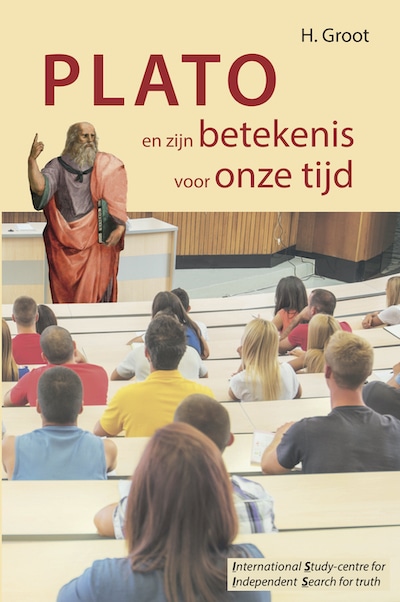
Plato en zijn betekenis voor onze tijd
€20,00
Dit boek is het resultaat van Herko Groot’s intensieve studie van Plato vanuit een theosofische achtergrond.
This unique work first appeared in 1947.
To our knowledge, there is no other study that has penetrated so deeply into the original thoughts of Plato and has been able to find the Universal Wisdom – the Theosophia (the Wisdom of the Gods) – so clearly. For anyone who wants to understand Plato better, this book is a must.
Plato is one of the Sages from the ancient world (born in 427 before our era) who is still widely known in our time. At least, by name. The substantive meaning of the work of Plato, the Initiate, is still difficult enough for the few who seriously delve into it.
Yet Plato is extremely interesting, and not only because of his still stimulating dialogues about, for example, the ideal society as described in The State can be found. Plato taught the Theosophy of ancient Greece, as Gottfried de Purucker writes in the first chapter of Foundations of Esoteric Philosophy. We may note that Plato, like every spiritual teacher, did not give his esoteric knowledge directly, but wrapped it in a number of veils to be penetrated by the student.
This knowledge is timeless and, when humanity is in crisis, there is an urgent need for knowledge about the light side of Nature.
De jaren veertig van de vorige eeuw vormden zonder twijfel een periode van crisis. In die jaren werkte de bekende Nederlandse astronoom en Theosoof Herko Groot aan een publicatie over Plato, waarvoor hij in de oorlogsjaren veel inspiratie opdeed in een besloten ‘Plato-kring’ in Laren. In 1947 verscheen bij uitgeverij Meulenhoff in Amsterdam zijn boek Plato and his significance for our time. From a theosophical perspective, it provides a crystal-clear insight into Plato's work. Groot describes in particular the Path inward, which leads to knowing the Self, also called Atma-Vidya in Theosophy, in detail. He explains very clearly what the similarities are between the meaning of the words that Plato chooses for this and the meaning of the Sanskrit terms such as Atma-Vidya, which Theosophy also uses in our time to express universal knowledge. Groot also provides even more clarity to Plato's well-known allegory of the cave. For those interested in Theosophy - for example, certainly for students of the courses Thinking Differently and Wisdom of Life - this book is an absolute must.
Het werk van Herko Groot is geschreven in de oude spelling en is al sinds lang niet meer verkrijgbaar. Daarom heeft Stichting I.S.I.S. besloten tot een nieuwe uitgave: Plato en zijn betekenis voor onze tijdThe text has been adapted to the contemporary Dutch spelling. The solemn language in the quotations from Plato and his colleagues has been maintained in order to preserve their character. The text therefore only deviates in the point of
the modern spelling differs from the original.
Contents
1. Directions in Greek philosophy before Plato
The Ionian School
Heraclitus
Eleatic School
Pythagoras and his school
The younger natural philosophers
The Sophists
Socrates
The life of Plato
2. The theory of ideas and the path of eros
Introduction to the theory of ideas
Justice as the core of ethics
The Way of Eros
3. The righteousness
The two worlds
The analogy of the soul and the state
The justice of the state
The Road to Justice
4. The path of insight
Philosophy and Atma-Vidyã
The Allegory of the Cave
The dialectic of her preparation
The path of insight from the other paths
Glossary
Chronological table
Short bibliography
Additional information
| Weight | 450 g |
|---|---|
| Dimensions | 240 × 160 × 18 mm |
| Writer | Groot, H. |
| Edition | Paperback |
| Pages | 287 |
| ISBN | 978-90-70163-76-1 |
| Language | Dutch |
| Publisher | Stichting I.S.I.S. Den Haag |
 English
  Dutch
Dutch